
Binance SOXL price band explained after a 5.9% fall

Binance’s perpetual tied to SOXL, a leveraged semiconductor ETF, recorded a 5.9% opening-to-low fall within the mark value used for margin danger in the course of the 21:00–22:00 UTC hour on Saturday, Oct. 17. All 60 sampled minute-close gaps between that mark and its reference index stayed beneath 3%.
The 2 observations measure totally different dangers. Binance’s printed weekend band constrains the mark’s distance from the index at a selected second. The index can transfer away from the dealer’s entry value, leaving cumulative value publicity open. Within the sampled hour, the index itself fell nearly 4%.
For a leveraged dealer, that distinction leaves room for losses and liquidation regardless of a slim mark/index hole. A reference-price safeguard and the quantity of collateral preserving a place open reply totally different questions.
Binance’s one-minute mark-price records present SOXLUSDT opening at 93.79 USDT at 21:00 UTC. The mark reached an intrahour low of 88.24 USDT inside the 21:41 minute, a 5.9151% opening-to-low decline. It completed the ultimate minute at 90 USDT, down 4% from the opening.
The corresponding index records present the reference transferring from 93.95 USDT on the opening to 90.22 USDT on the last minute shut, a 3.9% decline.
These are costs for a perpetual contract quoted and settled in Tether’s USDT, a stablecoin designed to trace the greenback. The data describe Binance’s by-product fairly than Saturday trades in SOXL shares on NYSE Arca.
| Sequence | 21:00 UTC opening | Last minute shut | Opening-to-close change |
|---|---|---|---|
| SOXLUSDT mark | 93.79 USDT | 90 USDT | −4.0409% |
| SOXLUSDT index | 93.95441168 USDT | 90.22315864 USDT | −3.9713% |
Matching every mark candle with the index candle for a similar minute provides 60 closing observations. At each one, the mark was beneath the index. The reductions ranged from about 0.00284% to 2.9%, all beneath the said 3% weekend restrict.
The low is an intraminute statement; the hole comparability makes use of matched minute closes. The pattern covers one hour and can’t set up tick-by-tick compliance.
The reference can transfer with the market
Binance’s detailed TradFi FAQ, displaying a Sept. 23 replace, describes a ±3% weekend and vacation mark/index constraint for equity-based perpetuals. It additionally reserves the precise to regulate deviation constraints throughout excessive market circumstances.
The index is the essential half. Procedures 67 and 68.5 of Binance’s presently printed Clearing Procedures describe an orderbook-derived reference throughout underlying-market weekends and different closures. It takes the typical of influence bid and influence ask costs and smooths it with an exponentially weighted transferring common.
That smoothing moderates how inputs feed right into a reference whereas permitting the reference to maneuver. If orderbook-derived inputs transfer decrease, a smoothed index can transfer decrease too, taking the extent round which the mark is constrained with it.
The 2 proportion calculations subsequently have totally different denominators. A mark/index hole compares two costs on the identical time. A dealer’s value return compares a later mark with an earlier value. A small hole between the present mark and index can coexist with a big transfer from an earlier entry value.
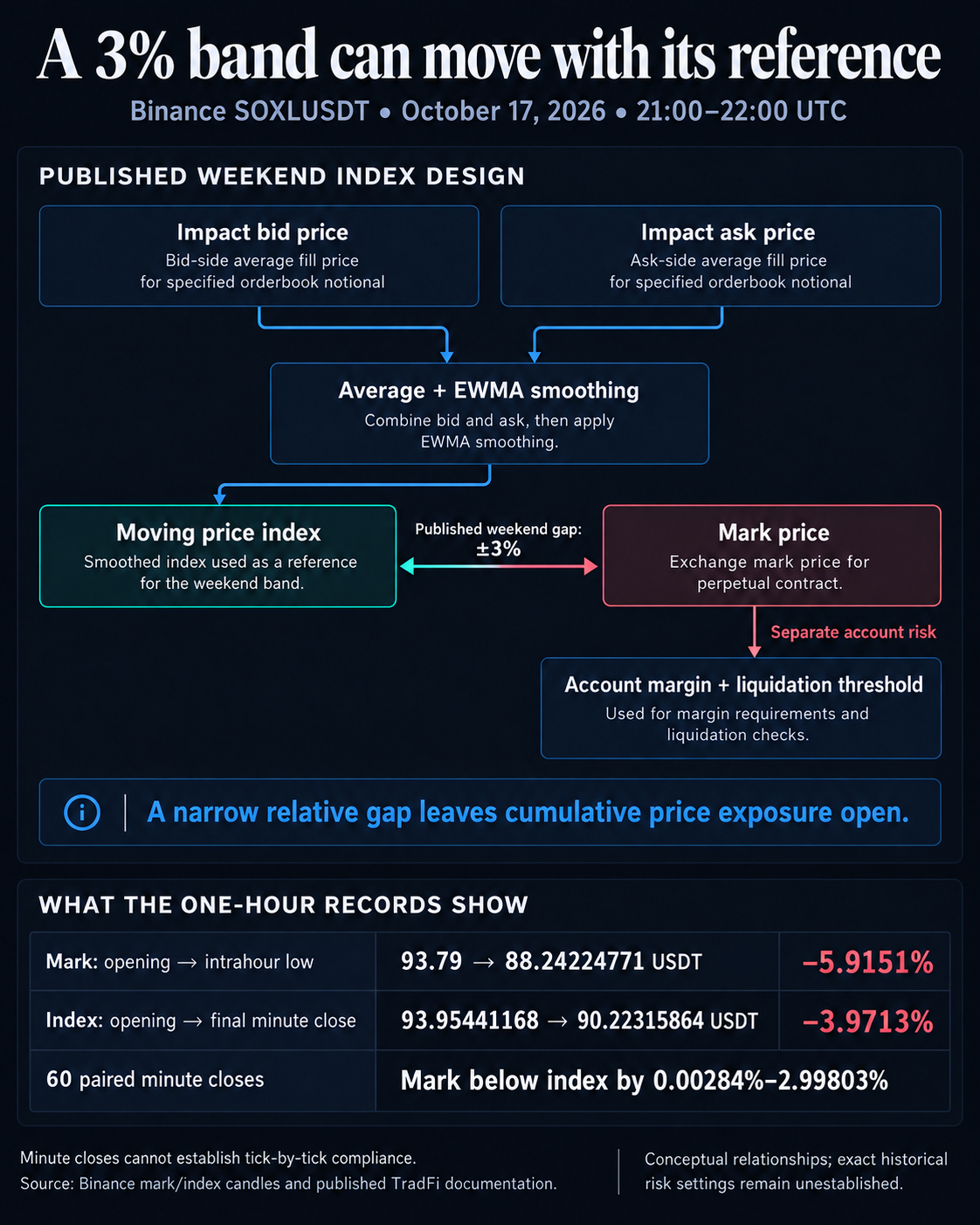
The excellence turns into seen when fairness perpetuals proceed buying and selling whereas their underlying shares don’t. The weekend index described within the procedures is derived from the orderbook fairly than a newly traded NYSE Arca share value. Its stage can subsequently change in the course of the closure.
Binance’s simpler learn-page summary nonetheless describes a set index exterior underlying buying and selling hours. That description differs from the detailed FAQ, which dates the substitute of fastened mode for fairness perpetuals throughout upkeep, holidays and weekends to Could 16, 2026, at 00:00 UTC. The documented change predates this October episode.
The SOXL specs place guidelines, specs and notices forward of basic steerage of their said hierarchy. The dated FAQ and present orderbook process describe a transferring reference, in distinction with the easier abstract’s fastened anchor.
Public descriptions additionally differ on the off-hours mark system. Process 51 describes nonregular-session smoothing, whereas the detailed FAQ makes the mark system conditional on the index mode. The precise historic rulebook revision, smoothing parameters and margin settings for this hour stay unestablished.
A value band is separate from the liquidation threshold
There are 4 costs or thresholds to maintain aside: the final execution value, the reference index, the mark used for margin danger and the liquidation value calculated for a place.
The SOXL contract specifications, printed Could 15, establish the underlying asset as the worth of 1 Direxion Each day Semiconductor Bull 3X ETF share on NYSE Arca. Holding the perpetual provides by-product publicity fairly than possession of that share.
These specs tie liquidation to the mark reaching the account’s relevant liquidation threshold. The calculation will depend on the margin association, together with cross or remoted margin, fairly than merely a 3% distance from the index.
The clearing procedures individually describe preliminary margin, upkeep margin and leverage tiers, and permit margin necessities to vary, together with for current positions.
SOXL provides one other distinct layer of leverage. Direxion targets 300% of the NYSE Semiconductor Index’s every day efficiency for SOXL and the inverse 300% for SOXS, earlier than charges and bills. Their every day aims go away longer-period cumulative returns depending on the return path.
That daily-reset habits is separate from the leverage chosen for an trade perpetual.
MarginPad’s Oct. 17 UTC recap lists $11.3 million in SOXL liquidated positions throughout 1,043 occasions in its full-day, cross-exchange feed. The determine measures liquidated place worth fairly than investor money losses.
A transferring index lets each costs fall collectively. The three% band limits their separation, whereas margin determines whether or not a leveraged place survives.