
Pump.fun copy traders risk buying the hype
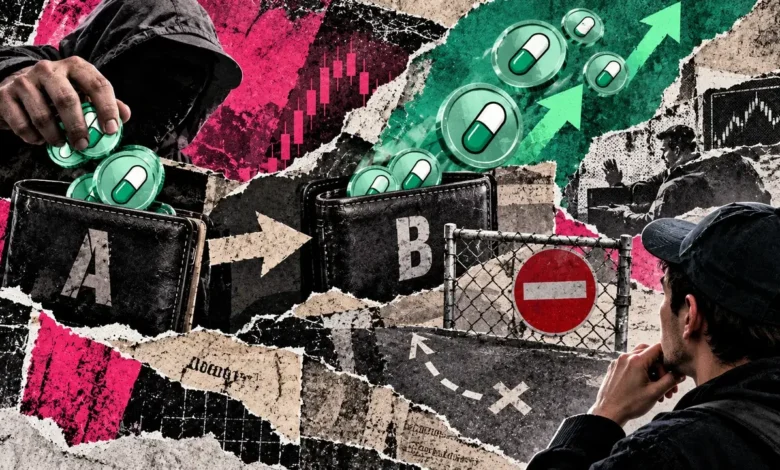
Pump.enjoyable copy merchants danger following wallets whose multimillion-dollar features come from transactions they can not replicate, new blockchain analysis exhibits.
An Oct. 22 investigation by Bitquery discovered that solely 26% of $752.5 million in giant memecoin pockets features handed its checks for standard market buying and selling, elevating questions in regards to the profitability rankings buyers use to determine profitable merchants.
The research examined 3,170 wallet-token positions with reported features of at the very least $100,000 between October 2025 and August 2026. It discovered that 51% of the features concerned wallets promoting tokens acquired from different addresses, whereas one other 13% exhibited patterns of doubtless coordinated buying and selling. The remaining 10% couldn’t be conclusively labeled.
The findings expose a weak spot in crypto copy buying and selling, the place buyers use automated platforms to reflect transactions made by wallets with sturdy historic returns.
These techniques sometimes depend on observable purchases to determine positions. Nevertheless, wallets receiving tokens by means of transfers can file substantial earnings with out executing a market buy that followers might replicate.
The follow additionally seems to be rising. Bitquery discovered that transferred-token gross sales accounted for seven out of each 10 giant pockets wins in August, after remaining under 100 circumstances month-to-month till July.
The shift means that merchants more and more counting on pockets leaderboards might encounter apparently worthwhile addresses whose buying and selling histories present little indication of the returns accessible to outdoors buyers.
Why worthwhile wallets might supply no trades to repeat
Bitquery recognized 1,579 worthwhile positions the place a lot of the tokens bought had arrived by means of transfers reasonably than purchases recorded by the promoting pockets.
Of these, 1,104 might be traced to addresses related to the token’s creator, both straight or by means of middleman wallets.
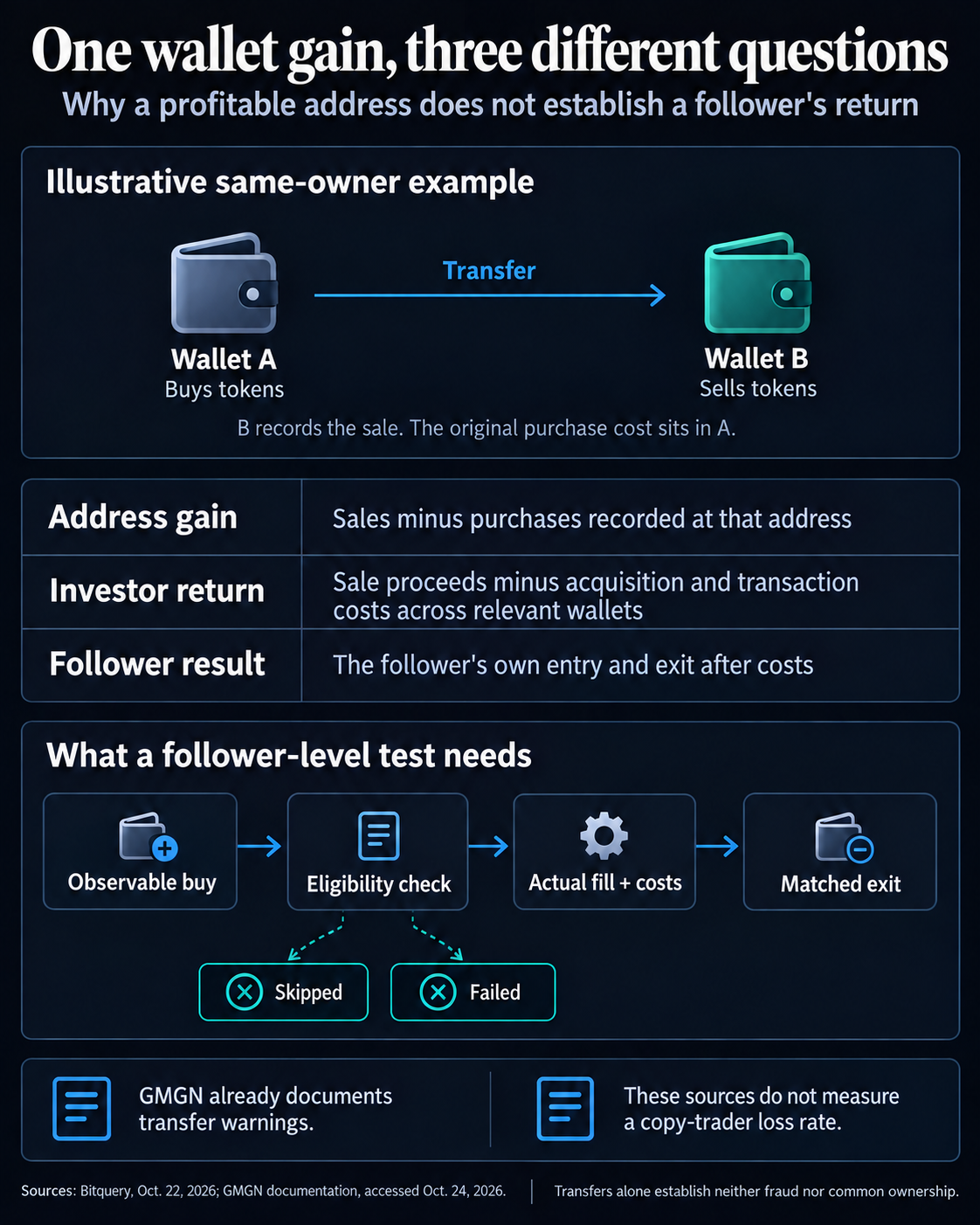
This association can distort address-level revenue calculations as a result of monitoring platforms sometimes subtract recorded purchases from gross sales to find out profitability.
An investor may buy tokens by means of one pockets, switch them to a different and subsequently promote them after a considerable worth enhance.
The receiving tackle might then show vital earnings regardless of recording no acquisition value. Nevertheless, the investor’s precise return would nonetheless rely on what the unique pockets paid.
A duplicate dealer monitoring the receiving tackle would see the eventual sale with out receiving the acquisition sign wanted to enter the place at a comparable worth.
Bitquery additionally recognized 423 creator-linked transfers involving further signing addresses. In a single instance involving the UOTF token, 4 momentary wallets acquired practically eight million tokens every earlier than forwarding them to promoting addresses in a coordinated transaction.
One recipient subsequently bought its holdings for $1.59 million, producing a big obvious achieve with out a corresponding recorded market buy.
Such transactions could make concentrated token distributions resemble profitable buying and selling exercise throughout a number of unbiased wallets.
Nevertheless, transfers also can happen between wallets belonging to the identical reliable investor. The absence of a recorded buy due to this fact doesn’t independently set up manipulation.
Bitquery discovered one other complication among the many greatest winners. Fifteen of the 25 largest reported features met its standards for wash loops, the place concentrated shopping for exercise coincided with direct monetary hyperlinks between wallets.
One instance concerned Enviornment, the place a pockets spent $4,223 earlier than recording roughly $4.92 million in gross sales.
One other tackle, beforehand funded by the obvious winner, accounted for 99% of shopping for exercise throughout the holding interval. Bitquery stated the vendor had transferred greater than $1.4 million in SOL to that purchaser over the previous two days.
The sample raises questions on whether or not an outsider might reproduce the returns with out entry to the identical shopping for help.
Copy-trading platforms face a profitability take a look at
The findings put higher scrutiny on the pockets analytics utilized by platforms reminiscent of GMGN, which permits buyers to watch addresses and routinely replicate their trades.
GMGN’s documentation already consists of warnings labeled “Did not purchase” and “Bought > Purchased,” figuring out addresses that obtain tokens with out buying them or promote greater than their recorded acquisitions.
Nevertheless, these indicators don’t set up whether or not the features displayed in a pockets’s buying and selling historical past might have been achieved by its followers.
GMGN’s copy-trading system executes purchases based mostly on shopping for transactions made by monitored wallets. Its proportional promoting function applies solely to tokens acquired by means of the copy-trading service.
Consequently, a pockets receiving tokens by means of transfers gives no corresponding market buy for the automated follower to reflect.
Even standard purchases introduce further obstacles. GMGN permits customers to configure liquidity, market capitalization and transaction-size filters that may stop orders from being copied.
The platform additionally fees a 1% dealing with charge per transaction, excluding community and precedence prices. Slippage and execution delays can additional scale back returns, notably when buyers comply with wallets buying and selling quickly.
Bitquery recognized real worthwhile exercise in its pattern, together with a SOULGUY place that generated $3.3 million throughout 3,632 trades. Replicating such efficiency would require followers to execute frequent transactions at sufficiently aggressive costs.
GMGN gives data of profitable and failed copied orders, providing a foundation for evaluating pockets exercise with precise execution. Its revealed documentation, nevertheless, doesn’t set up whether or not profitability rankings account for transferred stock or the returns accessible to followers.
The hole stays unmeasured. Bitquery didn’t study copy merchants’ precise efficiency, whereas one other 2,943 six-figure profitable positions closed after its August cutoff and stay outdoors the research’s switch evaluation.
Assessing these newer positions, alongside accomplished and missed copy-trading orders, would assist set up how a lot of the obvious profitability displayed on pockets leaderboards interprets into executable buying and selling alternatives.