
Polymarket reforms Bitcoin contracts and Binance trading spikes immediately drop

Polymarket’s five-minute Bitcoin contract sampled on Oct. 27 makes use of averaged opening and shutting benchmarks, following an August reform that modified the inducement to maneuver its settlement value.
The present design requires a special danger evaluation from the single-snapshot rule examined in earlier analysis.
An estimate of about $8.2 million earned by 821 wallets in earlier pushed cycles belongs to that historic analysis. Guangzhe Wang’s newer study cites the discovering from Dai and co-authors.
Wang’s before-and-after outcomes as a substitute level to a subsiding Binance buying and selling sample within the first weeks after averaging. That offers the reform an empirical check, whereas protecting separate whether or not an noticed settlement-time sample declined and the way a lot merchants lose underneath the present rule.
The Oct. 27 Bitcoin market, masking 12:20-12:25 p.m. ET, names Chainlink’s BTC/USD 60-second time-weighted common value (TWAP) as its decision supply. Up wins when the ending benchmark is no less than as excessive because the opening benchmark, and Down wins in any other case.
The Dai, Jia and Yu working paper, submitted to arXiv on June 30, reported settlement-time spot-flow spikes and subsequent reversals after the five-minute contract’s launch. The broader discovering considerations the inducement to maneuver the underlying reference market.
Wang’s newer paper examined Binance one-second information from July 1, 2025, by Sept. 4, 2026, with 82,752 Bitcoin boundaries the place solely the five-minute contract settled. For every sampled five-minute window, he measured the share of Binance quantity traded in its closing ten seconds:
| Regime | Last-ten-second quantity share |
|---|---|
| Earlier than five-minute contract launch | 3.05% |
| Single-snapshot settlement | 5.68% |
| 60-second common settlement | 3.02% |
Within the first three weeks of the 60-second regime, Wang discovered no systematic migration into earlier bins and no recurrence of the sooner near-strike reversal sample.
That bounded remark is in line with the reform’s effectiveness for the measured sample. It’s neither a present wallet-profit audit nor proof that each doable manipulation technique has disappeared.
The research assessments an noticed response to the reform, and its consequence is a buying and selling sample.
Two averages resolve the wager
Based on Polymarket’s changelog, crypto up/down markets switched from single snapshots to Chainlink-computed averages on Aug. 7. Each the opening value to beat and the ultimate settlement worth moved to the relevant TWAP feed.
On Aug. 14 at 00:00 UTC, the platform prolonged five-minute crypto markets to 60 seconds. The October contract displays an working rule launched greater than two months earlier, and its five-minute length shouldn’t be confused with its one-minute benchmark window.
Underneath a snapshot rule, an unusually temporary transfer may be vital if it impacts the chosen reference value. Underneath a median, its contribution is dependent upon how a lot of the measurement window it influences.
The financial query turns into whether or not the profit on the prediction-market place exceeds the price of affecting that common and executing the technique.
A historic greenback achieve can’t be carried into that modified calculation with out proof that the previous habits and economics nonetheless apply.
Polymarket’s documentation says it takes the relevant common, simply because it does for the closing worth. Evaluating a disputed outcome requires the reference values used at each boundaries, together with the related report timing.
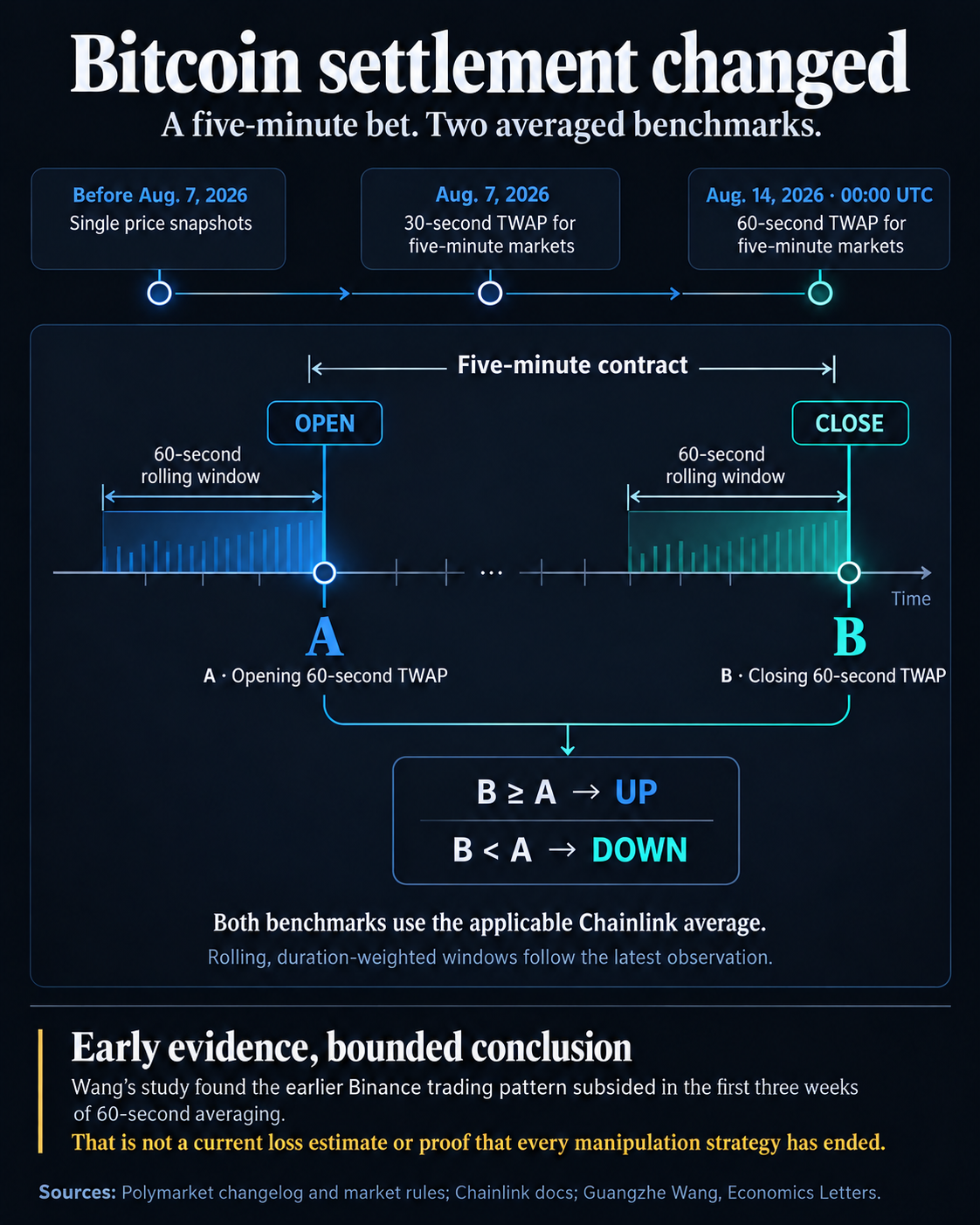
Chainlink’s timestamp documentation explains why the time printed on an change chart is inadequate. Every underlying report has a validity begin and an remark timestamp, however report widths can range, together with when a later report absorbs a niche. The TWAP weights costs by the length they cowl.
The typical additionally rolls with the most recent remark reasonably than robotically snapping to a spherical clock minute. A 60-second TWAP is due to this fact neither the common value throughout the complete five-minute wager nor essentially sixty equally weighted ticks.
What the previous greenback determine can’t reply
A achieve on a prediction-market place and the web return from a method involving the underlying asset are totally different measurements. If transferring Bitcoin’s reference value requires buying and selling Bitcoin, that leg and its execution prices belong within the profitability calculation.
Polymarket Institute distinguishes the decentralized worldwide change from Polymarket US, with separate APIs and individually managed information.
Talos’s Oct. 27 quarterly review highlights its Kalshi integration and factors to earlier evaluation of potential Polymarket settlement manipulation.
The remaining measurement is monetary in addition to behavioral: features and losses underneath the averaged rule, with the related underlying-market trades and execution prices accounted for.