
Bitcoin miners lose hashrate as hackers hijack up to 1,600 sites

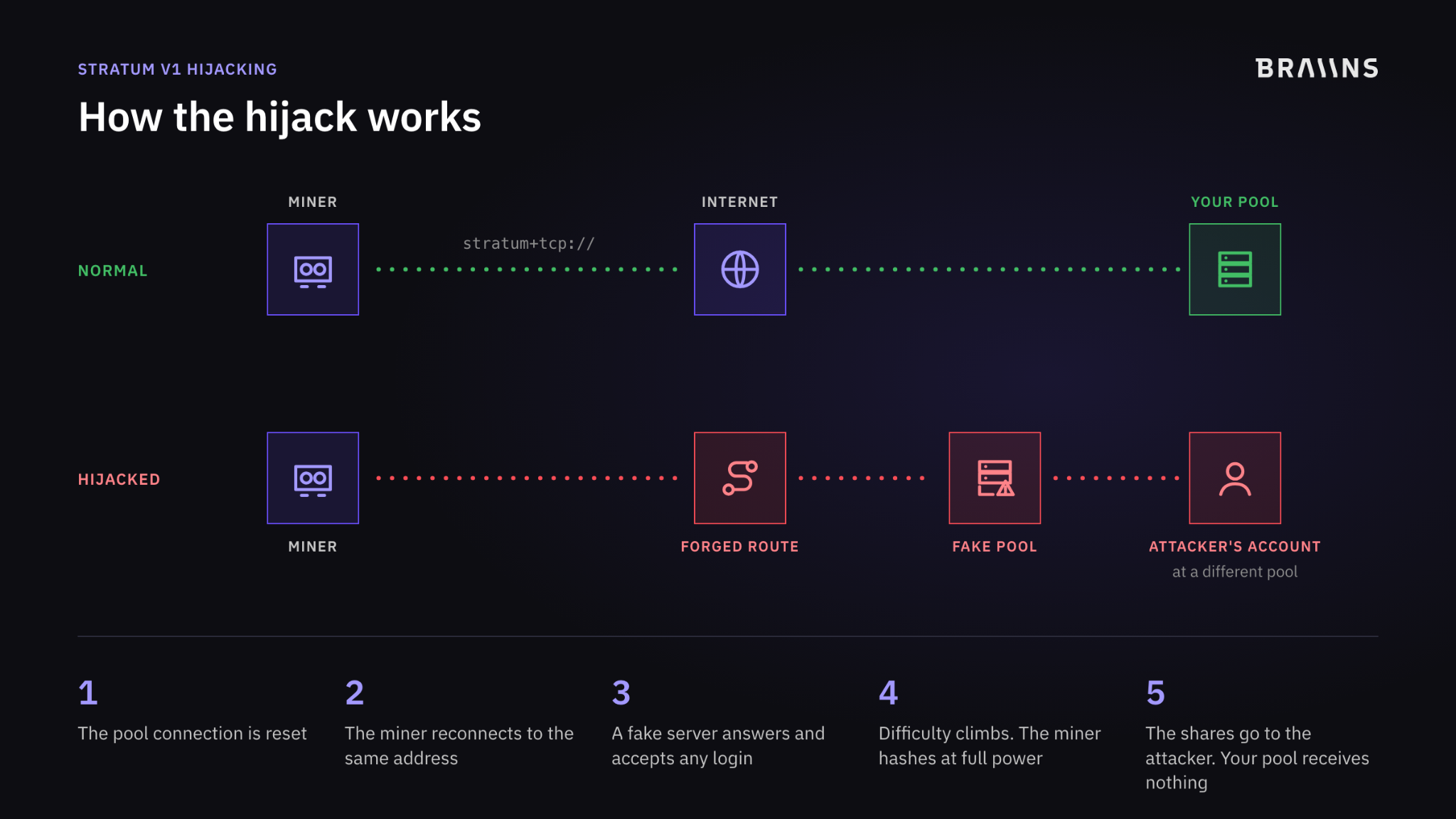
On the twenty fifth of November, Bitcoin mining firm Braiins warned that attackers had hijacked Bitcoin miners’ work by unencrypted pool connections.
Machines stored operating whereas another person acquired credit score. That mainly left operators paying electrical energy payments for work credited elsewhere.
Its investigation documented 4 episodes on the twentieth of November, largely in Europe. Every affected 1,050–1,600 mining websites and diverted 0.6–1.9 EH/s for six to 49 minutes.
Attackers solid web routing bulletins, referred to as BGP hijacking, to intercept connections and impersonate the pool. Miners reconnected to the identical deal with, making the change tough to identify.
Earlier episodes hit Latin America between the seventh and twelfth of November.
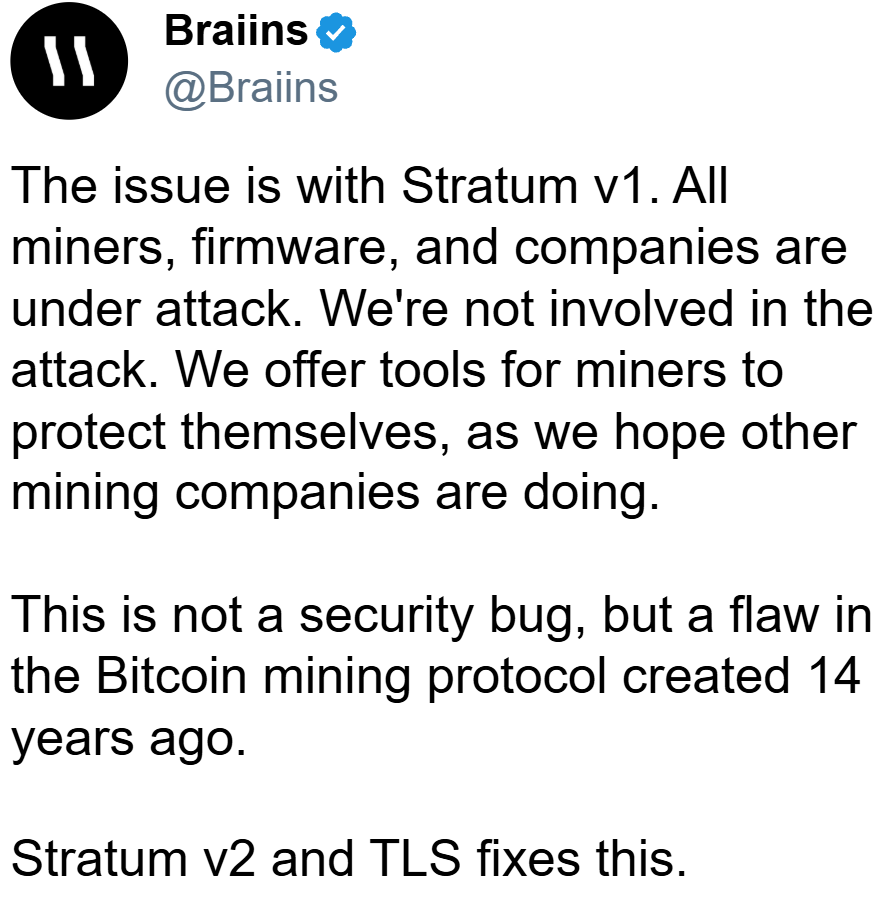
Responding to an X person, Braiins mentioned the assaults exploited a weak spot in Stratum V1, the protocol connecting miners to swimming pools. Stratum V2 contributor Pavlenex added,
That is an assault on MINERS and their infrastructure and isn’t a vulnerability in Braiins Pool.
Did earlier warnings result in upgrades?
The uncovered protocol dates again to 2012, and warnings have been issued for years.
Braiins had flagged hashrate theft on the 18th of April 2020. It argued that stopping stolen income and decreasing working bills would encourage upgrades extra successfully than decentralization alone.
That historical past prompted Turtlecute, who works in product advertising at Braiins, to write down,
For 14 years, we ignored SV1 points.
When an X person requested whether or not this was the primary publicly confirmed case, Pavlenex recalled earlier experiences of interception assaults.
By November, the monetary incentive for upgrading had turn into more durable to dismiss. Braiins reported that miners’ machines confirmed regular exercise whereas their pool dashboards recorded no credited hashrate.
How far had upgrades truly progressed?
Six months earlier, seven mining organizations had joined the Stratum V2 Working Group. These included ANTPOOL, Foundry, F2Pool, SpiderPool, Block, MARA Basis, and DMND.
Reportedly, the organizations represented roughly 75% of the worldwide hashrate on the time. Their backing gave the encrypted alternative substantial attain, however deployment remained uneven.
As of the twenty sixth of November, the official directory listed Braiins Pool and DMND as manufacturing swimming pools. It individually listed a number of solo swimming pools and MARA Basis’s industrial solo operation.
Foundry remained marked as work in progress, regardless of reported testing in November. ANTPOOL, F2Pool, and SpiderPool had been absent from the manufacturing listings.
The publicity prolonged past V2 adoption. Braiins mentioned most main swimming pools’ public endpoints nonetheless supplied solely unencrypted Stratum V1 throughout its checks on the twenty third of November.
Braiins CEO Eli Nagar urged,
Swimming pools, Miners, repair your URLs right this moment
V2 encrypts mining site visitors and verifies the pool’s identification, stopping an impersonator from receiving miners’ work. The November assaults confirmed the income penalties when business help had but to succeed in these connections.
Closing Abstract
- Braiins reported Bitcoin hashrate hijacking throughout 1,000-plus mining websites.
- Unencrypted connections and backups might redirect work whereas machines appeared wholesome.