
Solana bot turns just $12,000 into $1.4 billion in trading volume as fake liquidity floods Raydium

A single Solana pockets generated $1.4 billion in suspected wash trades, accounting for almost 1 / 4 of Raydium’s concentrated-liquidity quantity.
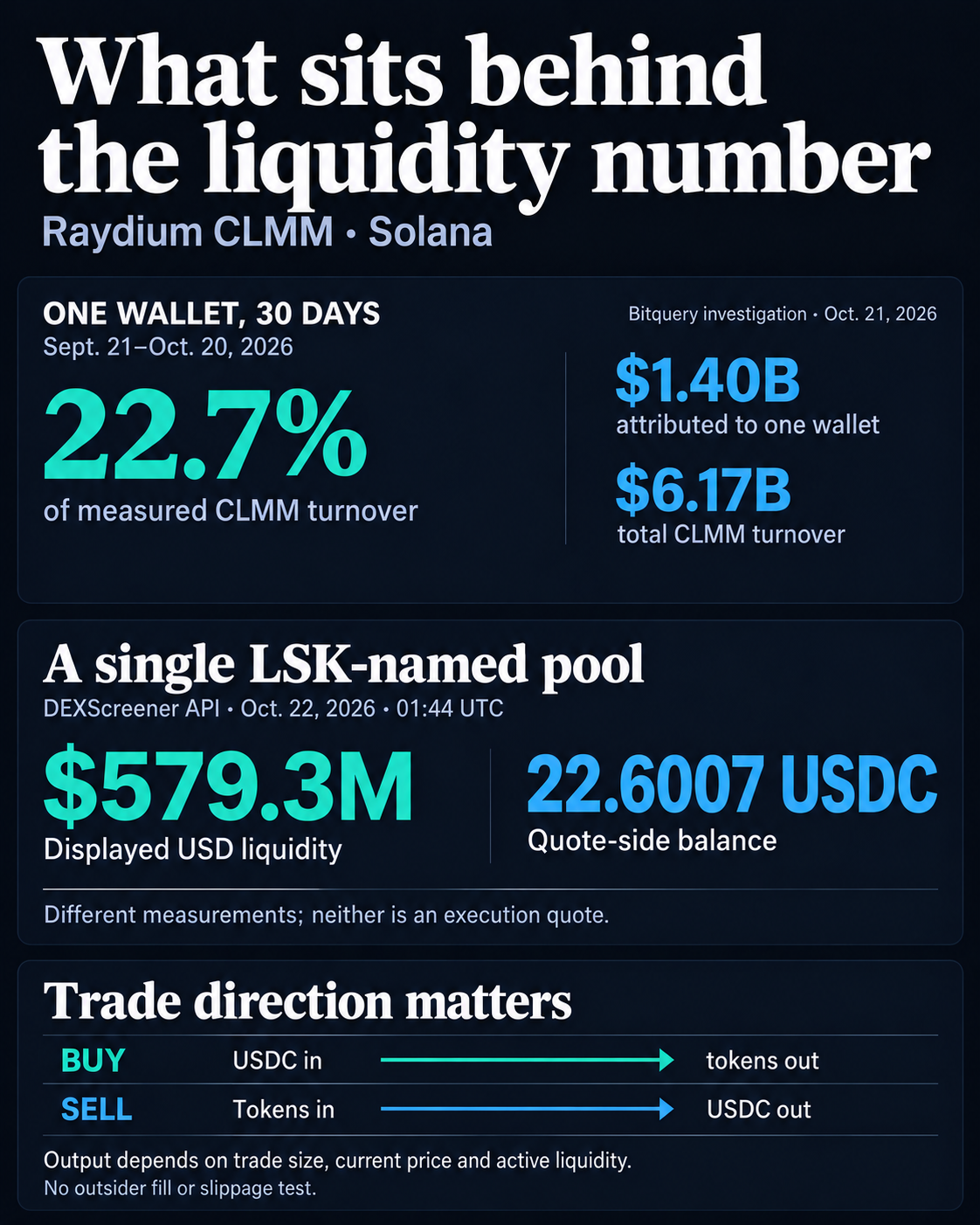
On Oct. 21, blockchain analytics agency Bitquery reported that the pockets accounted for 22.7% of the $6.17 billion traded throughout Raydium’s concentrated liquidity market maker (CLMM) swimming pools between Sept. 21 and Oct. 20.
The investigation recognized 108,871 swaps throughout 438 swimming pools, many containing tokens that imitated established cryptocurrencies corresponding to XRP, Litecoin, Monero, and Lisk. Bitquery traced the exercise to a suspected wash-trading operation that used about $12,000 in working capital to repeatedly generate transactions value hundreds of thousands of {dollars}.
The findings increase recent considerations concerning the reliability of decentralized change buying and selling volumes and liquidity figures, which traders steadily use to evaluate market exercise and decide whether or not tokens will be purchased or offered with out substantial worth disruption.
The operation relied on quickly shopping for tokens and promoting them again into the identical swimming pools, permitting a comparatively small quantity of capital to generate substantial reported turnover.
In a single Oct. 20 transaction, the pockets exchanged 11,102 USDC for tokens in a pool carrying Lisk’s LSK ticker, then offered them again 22 seconds later for 11,100.87 USDC.
That transaction generated roughly $22,200 in recorded buying and selling quantity at a value of simply $1.13, excluding community charges. Bitquery recognized 22,685 accomplished spherical journeys throughout the reporting interval.
Faux token swimming pools show billions in questionable liquidity
The investigation additionally discovered substantial discrepancies between the liquidity proven on common buying and selling platforms and the greenback reserves backing the suspected operation’s token swimming pools.
In keeping with Bitquery, ten swimming pools linked to the pockets confirmed about $5.93 billion in mixed liquidity on DEXScreener, regardless of holding simply $10,238 in USDC reserves.
One pool utilizing Lisk’s ticker displayed $579 million in liquidity whereas holding roughly $19 in USDC when Bitquery examined it.
The large valuation got here from almost one billion tokens priced at about $0.58 every, near the market worth of the reliable Lisk cryptocurrency.
Nonetheless, the displayed valuation supplied little assurance that traders might liquidate substantial positions with out severely disrupting the value. Precise execution relies on the liquidity accessible at prevailing costs, notably in concentrated-liquidity swimming pools.
Bitquery discovered related preparations involving tokens utilizing tickers related to Monero, XRP, Ethereum, and different established cryptocurrencies.
The swimming pools had been additionally showing prominently in token searches, doubtlessly exposing traders on the lookout for reliable property to equally named tokens with deceptive buying and selling statistics.
In a single instance, the investigation discovered that seven of the highest ten DEXScreener search outcomes for XMR had been related to the suspected cluster.
Extra wallets appeared to strengthen the operation. Bitquery recognized 12 suspected helper wallets that collectively executed about 1.25 million swaps, including exercise throughout 1000’s of swimming pools.
Regardless of the large reported turnover, solely 4 wallets exterior the suspected cluster traded its swimming pools the earlier week, producing about $27 in mixed transactions.
The findings construct on CryptoSlate’s September reporting, which detailed Bitquery’s identification of $117.7 billion in round or bot-like exercise throughout its broader Solana decentralized change pattern.
The most recent investigation identifies a extra concentrated operation able to influencing a considerable share of 1 Raydium buying and selling phase whereas producing market statistics that would mislead exterior individuals.
Bitquery linked the wallets by shared buying and selling swimming pools, funding sources, and direct transfers, however didn’t establish the operator or set up investor losses. The findings additionally don’t set up Raydium’s involvement or the involvement of the buying and selling platforms displaying the swimming pools.
The proof leaves an unresolved threat for decentralized buying and selling platforms: whether or not their quantity rankings, token searches and liquidity shows can distinguish independently funded markets from coordinated buying and selling exercise earlier than unsuspecting traders commit capital.