What Is Algorand (ALGO)? A Beginner’s Guide
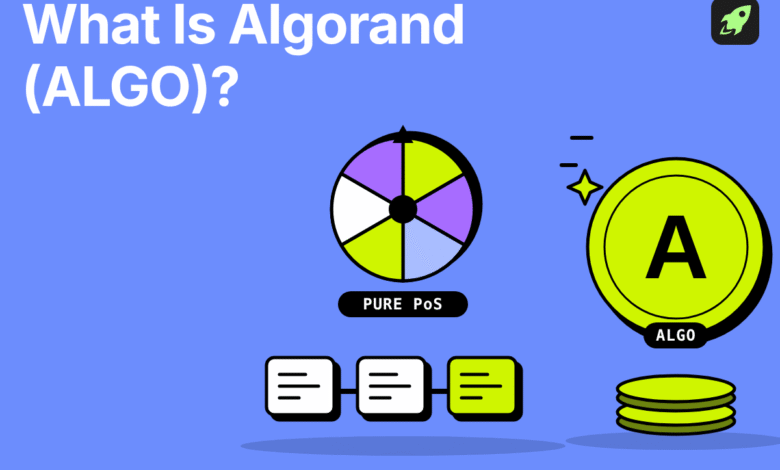
Algorand is a public, permissionless Layer 1 blockchain constructed for funds, digital belongings, and purposes. ALGO is its native coin. The community makes use of a consensus mannequin referred to as Pure Proof of Stake, which randomly selects block producers in proportion to the ALGO they maintain on-line, so it requires no mining or locked deposits. Blocks arrive roughly each three seconds, and as soon as a block is licensed, its transactions are closing.
This information explains what Algorand is, who created it, how its consensus works, what ALGO is used for, what it prices to make use of the community, and the dangers you must perceive before you purchase, maintain, or construct on it.
What Is Algorand (ALGO)?
Algorand is a blockchain platform: a shared ledger that 1000’s of computer systems maintain in sync and not using a central operator. Anybody can create an account, ship transactions, concern tokens, or deploy good contracts. Nobody wants permission to affix.
The community has one native asset, the ALGO coin. You want it to pay transaction charges, maintain an account lively, and take part in consensus. Each different token on Algorand, from stablecoins to NFTs, is an Algorand Customary Asset (ASA) issued on prime of the protocol.
Three design selections set Algorand aside:
- Pure Proof of Stake (PPoS). Consensus affect relies on how a lot ALGO an account brings on-line. There isn’t a proof-of-work mining.
- Random committee choice. Every spherical, the protocol secretly and randomly picks who proposes a block and who votes on it.
- Quick finality. A transaction in an authorized block doesn’t get reversed by a later chain reorganization.
The best way to Get Free Crypto
Easy tips to construct a worthwhile portfolio at zero price

Who Created Algorand?
Silvio Micali, a cryptographer and MIT professor, based Algorand in 2017. Micali obtained the Turing Award in 2012 for his work in cryptography, together with zero-knowledge proofs and verifiable random features. That second idea sits on the heart of how Algorand selects block producers.
The Algorand mainnet and the ALGO coin went stay in June 2019. Immediately, two organizations assist the community: the Algorand Basis, which manages the ecosystem treasury, governance, and grants, and Algorand Applied sciences, the corporate behind a lot of the core protocol improvement. The protocol code is open supply, and anybody can run a node.
How Does Algorand Work?
Algorand reaches settlement on new blocks by Pure Proof of Stake. Right here is the essential thought.
Any account holding ALGO can register as an “on-line” account. To try this, the proprietor generates participation keys on a node and indicators a transaction that hyperlinks these keys to the account. Participation keys are particular credentials used just for consensus. They will signal votes and block proposals, however they can’t spend the account’s funds.
For each spherical, the protocol runs cryptographic sortition, a lottery that makes use of a verifiable random operate (VRF). A VRF is a cryptographic technique that produces a random-looking output and a proof anybody can confirm. Every on-line account runs the lottery privately utilizing its personal keys. If it wins, it will get a proof of choice it may well present to the remainder of the community.
The extra on-line stake an account has, the upper its probability of choice. On common, an account with 2% of the net stake will probably be chosen about twice as usually as one with 1%.
Sortition fills two roles in every spherical:
- Block proposers assemble a candidate block from pending transactions and broadcast it.
- Voting committees assessment the proposals and vote on which block to simply accept.
As a result of choice occurs privately, no one is aware of who will suggest or vote till these accounts reveal their proofs. By then, they’ve already despatched their message. An attacker can’t goal the following committee prematurely, and a brand new committee is chosen for every step.
Your ALGO stays in your account the entire time. PPoS doesn’t lock cash, and there’s no slashing (an automated penalty that destroys a part of a validator’s stake). You possibly can spend ALGO from an internet account anytime. Your consensus weight merely follows your stability.
How a Transaction Turns into Ultimate
Here’s what occurs while you ship ALGO to a buddy:
- Your pockets indicators the transaction and sends it to a node.
- The node checks it and passes it throughout the community.
- A particular block proposer consists of the transaction in a candidate block.
- Voting committees run by a number of rounds of voting till a supermajority agrees on one block.
- The block is licensed and added to the ledger.
As soon as step 5 is finished, the transaction is closing. On Bitcoin, exchanges usually watch for a number of extra blocks as a result of a competing chain may exchange current ones. Algorand’s consensus design doesn’t produce competing forks beneath regular operation, so customers don’t want to attend for additional confirmations. Rounds at the moment take about 2.8 seconds on common, which implies a cost usually settles in beneath three seconds.
This finality is a property of the protocol beneath its safety assumptions. The primary one is that an sincere supermajority of the net stake, greater than two-thirds, follows the foundations. If that assumption broke, the ensures would not maintain. That has not occurred, however “closing” right here describes how the protocol is designed, not a promise towards each doable failure.
Validator Nodes, Repeater Nodes, and Community Routing
Algorand nodes tackle completely different roles:
- Validator nodes (additionally referred to as participation nodes) maintain participation keys for a number of on-line accounts. They suggest blocks and vote when the community selects their accounts. They don’t have to retailer the complete ledger historical past.
- Repeater nodes (traditionally referred to as relay nodes) deal with networking. They cross transactions, blocks, and votes between validators so messages unfold rapidly throughout the globe.
- Archival nodes retailer the whole historical past of the chain for explorers, indexers, and new nodes catching up.
Within the traditional setup, validators join solely to repeaters, and repeaters join to one another. This hub-like design retains message delay low, however it additionally relied on a comparatively small set of relay operators. Algorand has been transferring to a peer-to-peer gossip community the place validators can uncover repeaters on their very own, and repeaters are permissionless, decreasing that dependence.
What Is ALGO Used For?
ALGO is a utility coin with three essential jobs on the community.
Transaction Charges and Minimal Balances
Each transaction on Algorand pays a payment in ALGO. That features ALGO funds, ASA transfers, and good contract calls. The payment goes to a protocol account referred to as the payment sink, and a part of it now goes to dam proposers as a reward.
Each account should additionally maintain a minimal stability. A fundamental account should maintain at the least 0.1 ALGO. This requirement works as a deposit for the house your account takes up on the ledger, and it rises as you retailer extra information. You’ll discover the precise figures in the associated fee part beneath.
Consensus Participation and Rewards
ALGO weights an internet account’s participation in consensus. Extra ALGO on-line means extra probabilities to suggest blocks and serve on voting committees, so the community’s safety relies on that holder behaving actually.
Since early 2025, Algorand pays protocol staking rewards to eligible block proposers. Extra on how that works beneath.
Provide and Circulation
The utmost provide of ALGO is 10 billion cash, all created when the community launched in 2019. No new ALGO will ever be minted.
The circulating provide is beneath 10 billion as a result of the inspiration and ecosystem wallets have regularly launched a part of the unique allocation over time. That quantity retains altering, so examine a stay supply, such because the Algorand Basis’s transparency reviews or a market information web site, and be aware the date earlier than counting on it.
What Does It Value to Use Algorand?
Algorand is affordable to make use of, although “low-cost” has a number of transferring components:
| Value merchandise | Quantity | Notes |
| Base transaction payment | 0.001 ALGO | Typical payment when the community isn’t congested |
| Account minimal stability | 0.1 ALGO | Required for any account to exist on-chain |
| Every ASA held or created | +0.1 ALGO | Added to the account’s minimal stability |
| Every app opted into or created | +0.1 ALGO and up | Grows with the quantity of on-chain storage |
The 0.001 ALGO base payment applies to virtually each transaction, whether or not it’s a easy cost or a sensible contract name. It’s the minimal, not a hard and fast value. If the community will get congested, charges can rise based mostly on transaction dimension, and a few good contract calls pay additional to cowl extra work.
The minimal stability isn’t spent. It stays in your account and frees up while you take away the information. For instance, if you happen to decide out of an ASA, your minimal stability drops by 0.1 ALGO. Any transaction that might push your stability beneath the minimal will fail, which is a standard shock for brand new customers.
What Can Individuals Construct on Algorand?
Algorand does greater than transfer ALGO from one pockets to a different. Builders use it to concern tokens and run on-chain applications.
Create and Obtain Algorand Customary Belongings
Algorand Customary Belongings are tokens created by the protocol itself, not a separate good contract. That makes them completely different from Ethereum‘s ERC-20 tokens, which every stay inside their very own contract.
ASAs can signify:
- fungible tokens, akin to stablecoins (USDC runs on Algorand as an ASA), loyalty factors, or in-game currencies;
- distinctive belongings, akin to NFTs, certificates, or tokenized real-world gadgets.
Issuers can set non-compulsory controls, together with the flexibility to freeze or claw again tokens. These are helpful for regulated belongings however price checking before you purchase a token.
To obtain an ASA, an account typically has to decide in first. Opting in means sending your self a zero-amount switch of that asset, which tells the community you agree to carry it. This blocks spam tokens from touchdown in your pockets, however it additionally means a switch will fail if the recipient hasn’t opted in. Every opt-in raises your minimal stability by 0.1 ALGO.
Use Sensible Contract Purposes
Sensible contracts on Algorand are referred to as purposes. Builders write them in high-level languages akin to Algorand Python or Algorand TypeScript, which compile right down to TEAL, the community’s low-level programming language. The Algorand Digital Machine (AVM) then runs that compiled code on each node.
Customers work together with an utility by sending it a transaction. Some purposes additionally require an opt-in in the event that they retailer information in your account.
Frequent makes use of embody decentralized exchanges, lending protocols, staking swimming pools, NFT marketplaces, and tokenization platforms. Algorand additionally helps atomic transfers, which bundle as much as 16 transactions so all of them succeed or all fail collectively. That makes trades between two events safer, since one facet can’t obtain belongings with out the opposite facet paying.
Can You Earn Rewards by Holding or Staking ALGO?
Sure, however not simply by holding ALGO in a pockets. You must participate in consensus.
Algorand launched protocol staking rewards with the Algorand 4.0 improve in January 2025. When an eligible on-line account proposes a block that the community accepts, it receives:
- a share of the transaction charges in that block (at the moment 50%);
- a bonus funded by the Algorand Basis, which began at 10 ALGO per block and shrinks by 1% each million blocks over a deliberate interval of roughly two years.
To qualify for these protocol rewards, a person account will need to have at the least 30,000 ALGO on-line. Anybody can nonetheless run a validator and take part in consensus with a lot much less, even a small quantity, however accounts beneath the edge don’t earn protocol rewards.
Holders with lower than 30,000 ALGO can be part of third-party staking swimming pools or liquid staking providers. These mix deposits from many customers to satisfy the edge after which share the rewards. Every service has its personal phrases, charges, and good contract dangers, so that they work in another way from solo staking.
The older Algorand governance rewards program, the place holders earned ALGO for committing cash and voting, resulted in 2025. The ultimate rewarded interval closed on March 31, 2025. Governance votes proceed, however they not pay rewards.
Reward quantities rely in your stake, how usually your account is chosen, community payment quantity, and the declining basis bonus. Deal with any APY determine you see as an estimate, not a hard and fast price.
How Is Algorand Completely different From Bitcoin and Ethereum?
| Characteristic | Bitcoin | Ethereum | Algorand |
| Consensus | Proof of labor (mining) | Proof of stake (validators) | Pure Proof of Stake |
| Typical block time | About 10 minutes | 12 seconds | About 2.8 seconds |
| Finality | Probabilistic; customers usually wait 6 blocks | Ultimate after about 13 minutes | Quick as soon as a block is licensed |
| Staking requirement | Not relevant | 32 ETH per solo validator, locked | No lock-up; 30,000 ALGO for protocol rewards |
| Slashing | No | Sure | No |
| Provide cap | 21 million BTC | No mounted cap | 10 billion ALGO |
| Tokens | Restricted native assist | ERC-20 good contracts | Constructed-in ASAs |
Bitcoin secures its ledger by burning electrical energy by mining. It focuses on being a retailer of worth and has a intentionally restricted scripting system. Algorand makes use of far much less power and helps tokens and full good contracts out of the field.
Ethereum additionally makes use of proof of stake, however its validators should lock 32 ETH and danger slashing for misbehavior. Ethereum has a a lot bigger developer group and extra decentralized purposes. Algorand gives sooner settlement, decrease and extra predictable charges, and native tokens that don’t depend upon particular person contract code.
What Are Algorand’s Limitations and Dangers?
No blockchain is freed from trade-offs. Listed here are the principle ones for Algorand.
Protocol and Community Commerce-Offs
- Safety assumptions. Algorand’s finality relies on greater than two-thirds of the net stake being sincere. If a single social gathering or coalition managed sufficient on-line stake, it may disrupt consensus.
- Stake focus. Consensus weight follows ALGO balances. Giant holders, together with basis wallets and exchanges, can carry vital affect if they bring about their cash on-line.
- Community structure. For years, Algorand relied on a reasonably small set of relay operators. The transfer to a peer-to-peer community addresses this, however how decentralized that layer turns into in observe continues to be price watching.
- Ecosystem dimension. Algorand’s DeFi and app ecosystem is smaller than Ethereum’s or Solana‘s. That may imply thinner liquidity and fewer instruments.
- Rewards funding. Half of the present staking rewards comes from a foundation-funded bonus that shrinks over time. Over the long term, rewards will rely extra on transaction charges.
Dangers for Customers
- Worth volatility. ALGO’s value can swing sharply. Like different cryptocurrencies, it may well lose a big share of its worth rapidly.
- Altering circulating provide. As extra of the ten billion ALGO enters circulation, the added provide can put stress on the worth.
- Decide-in and minimal stability errors. Sending an ASA to an account that hasn’t opted in will fail, and dropping beneath the minimal stability blocks transactions. Neither loses funds, however each confuse new customers.
- Faux tokens. Anybody can create an ASA with any title. At all times examine the asset ID, not simply the ticker, earlier than shopping for or opting in.
- Sensible contract and staking pool danger. Bugs, exploits, or poor administration in third-party apps and swimming pools can result in losses. The protocol itself doesn’t slash stake, however a pool’s contract can nonetheless fail.
- Key administration. Should you lose your restoration phrase, no one can restore your ALGO. Retailer it offline and by no means share it.
- Regulation. Guidelines on crypto belongings, staking providers, and token issuance differ by nation and maintain altering.
Ultimate Phrases
Algorand is a Layer 1 blockchain Silvio Micali designed to settle transactions in seconds with fast finality. Its Pure Proof of Stake mannequin makes use of verifiable random features to pick block proposers and voting committees, retains ALGO liquid whereas securing the community, and avoids mining’s power price. ALGO pays transaction charges, covers minimal balances, and weights every on-line account’s say in consensus. Holders with 30,000 ALGO or extra can earn protocol rewards immediately.
The community additionally has clear limits: a smaller ecosystem than the biggest chains, rewards that partly depend upon a shrinking basis bonus, and the same old value swings of any crypto asset. Learn up on the opt-in system and minimal stability earlier than you begin, and examine asset IDs earlier than accepting tokens.
Disclaimer: Please be aware that the contents of this text usually are not monetary or investing recommendation. The data supplied on this article is the writer’s opinion solely and shouldn’t be thought of as providing buying and selling or investing suggestions. We don’t make any warranties in regards to the completeness, reliability and accuracy of this info. The cryptocurrency market suffers from excessive volatility and occasional arbitrary actions. Any investor, dealer, or common crypto customers ought to analysis a number of viewpoints and be aware of all native laws earlier than committing to an funding.