Who Is Vitalik Buterin? Ethereum’s Co-Founder Explained

Key takeaways
- Vitalik Buterin’s November 26 essay argues that crypto safety should lengthen to the bodily chips inside units, summed up as “Not your silicon, not your keys.”
- He needs producers to publish bodily chip layouts (GDS recordsdata) so investigators can evaluate actual {hardware} in opposition to the design.
- Researcher Andrew Huang’s infrared inspection approach (IRIS) can study chips with out eradicating them, nevertheless it has decision limits and isn’t a common repair.
- The essay is a proposal, not a declare that current {hardware} wallets are compromised, and publishing it doesn’t give Buterin energy to vary Ethereum unilaterally.
- Arkham attributes about $390 million in belongings to Buterin, largely roughly 224,000 ETH, although his true internet price shouldn’t be publicly established.
Who’s Vitalik Buterin, and why is Ethereum’s co-founder now questioning the safety of the very units crypto traders use to guard their wealth? The 32-year-old programmer has turned his consideration to an issue that even open-source software program can not essentially resolve: compromised laptop chips.
In an essay revealed on November 26, Buterin argued that cryptocurrency security needs to extend beyond software and into the bodily {hardware} on which it runs. His message builds on one in every of crypto’s oldest ideas, however with a brand new twist:
“
Not your silicon, not your keys.
Vitalik Buterin · Essay, November 26
For somebody who helped construct a substitute for centralized monetary infrastructure, questioning the producers behind that infrastructure looks like a pure subsequent step.
It additionally displays a safety philosophy that has change into more and more seen in Buterin’s work, from his push for greater privacy and quantum safety on Ethereum’s roadmap to his curiosity in independently verifiable computing.
Who Is Vitalik Buterin?
Vitalik Buterin is a Russian-Canadian programmer, researcher and author who conceived Ethereum in 2013, on the age of 19.
Born in Russia in 1994 and raised in Canada, Buterin found Bitcoin in 2011. He went on to co-found Bitcoin Journal, the place he explored the know-how and economics behind cryptocurrencies lengthy earlier than digital belongings attracted mainstream monetary establishments.
His involvement in Bitcoin uncovered him to an issue that will finally result in Ethereum. Blockchain know-how had potential past transferring cash, however constructing extra subtle functions on Bitcoin offered technical limitations.
Relatively than attempting to accommodate each potential utility inside Bitcoin’s current structure, Buterin started engaged on a blockchain designed particularly for programmability.
On the time, he was finding out laptop science on the College of Waterloo, the place he additionally labored as a analysis assistant to cryptographer Ian Goldberg.
In accordance with the College of Waterloo, Buterin received a $100,000 Thiel Fellowship in 2014 and subsequently left college to work on Ethereum full-time.
How Vitalik Buterin Created Ethereum
In November 2013, Buterin wrote the preliminary draft of what would change into the Ethereum whitepaper.
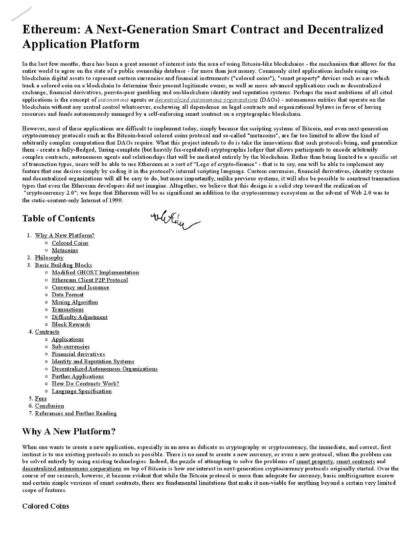
The proposal described a blockchain with a general-purpose programming atmosphere. Builders would now not must create a wholly new community each time they needed to construct a decentralized utility.
Take into account a lending platform. As a substitute of counting on a financial institution to handle collateral, calculate curiosity and authorize withdrawals, builders may encode these guidelines into good contracts operating on Ethereum.
That doesn’t get rid of each danger. Good contracts can comprise bugs, rely on unreliable exterior knowledge or function below centralized administrative controls. What Ethereum launched was the power to execute monetary and different programmable agreements on a shared blockchain.
Though Buterin originated the idea, Ethereum was not constructed by him alone. Its founding group included seven different people: Gavin Wooden, Joseph Lubin, Charles Hoskinson, Anthony Di Iorio, Mihai Alisie, Jeffrey Wilcke and Amir Chetrit.
The undertaking’s first dwell community, often called Frontier, launched on July 30, 2015.
What started as an experimental computing platform finally grew to become the muse for a lot of the decentralized finance trade. Stablecoins, decentralized exchanges, lending protocols and tokenized monetary belongings now use the infrastructure that Buterin and Ethereum’s early contributors helped set up.
The community’s personal evolution, notably its transition to proof-of-stake and the event of Layer 2 scaling networks, has formed Ethereum’s first decade.
Vitalik Buterin’s Newest Warning: Can Crypto Wallets Actually Be Trusted?
A {hardware} pockets is meant to maintain non-public keys away from probably compromised computer systems and smartphones. However what occurs if the machine itself can’t be trusted?
Buterin’s newest analysis examines that chance. He factors to produce chain assaults involving tampered wallets and considers the potential for malicious modifications hid inside apparently authentic chips.
Open-source firmware permits researchers to look at the directions a tool runs. However these directions reveal little about whether or not the manufactured chip has been altered.
Buterin needs producers to reveal bodily chip layouts, often called GDS recordsdata, so investigators have a reference in opposition to which to examine precise {hardware}.
The excellence issues. Realizing what a chip is designed to do shouldn’t be essentially the identical as understanding what the chip inside your pockets truly does.
The Expertise That May Assist Detect Compromised Chips
One strategy highlighted by Buterin comes from {hardware} safety researcher Andrew Huang, higher often called bunnie.
Huang has been growing a way known as Infra-Red, In Situ inspection (IRIS), which exploits the truth that silicon turns into clear at sure infrared wavelengths.
Utilizing infrared illumination and appropriate imaging gear, researchers can study components of a chip’s inside construction with out essentially eradicating it from its circuit board.
The approach may assist detect substituted elements or surprising variations between manufactured chips and their meant designs.
Nevertheless, it’s not a common resolution.
In a 2024 replace on his analysis, Huang explained that infrared imaging has resolution limits. It can not reliably reveal each microscopic function of recent chips. Combining imaging with further electrical testing may enhance confidence in a part’s integrity.
That is a vital limitation for crypto traders. Publishing an open {hardware} design doesn’t mechanically make a pockets safe, simply as publishing a sensible contract’s code doesn’t set up that it is freed from vulnerabilities.
Buterin acknowledges that subtle {hardware} inspections usually tend to be carried out by specialist organizations than unusual pockets house owners.
His essay is a proposal for enhancing safety, not an announcement that current {hardware} wallets have all been compromised.
Does Vitalik Buterin Management Ethereum?
Regardless of his standing as Ethereum’s most recognizable co-founder, Buterin shouldn’t be its CEO.
Ethereum is maintained by means of the participation of impartial builders, researchers, node operators, validators and different ecosystem contributors. Adjustments to the community contain technical proposals, dialogue, software program growth and adoption by contributors.
Buterin has appreciable affect over these discussions, however publishing a proposal doesn’t give him the authority to implement it unilaterally.
His function inside the Ethereum Basis can be distinct from management over the blockchain itself. In its April 2025 governance announcement, the Basis described Buterin’s obligations as offering technical and mental steering to the broader ecosystem.
His analysis can affect the course Ethereum takes. Whether or not the community in the end follows that course is dependent upon significantly greater than his endorsement.
How A lot Is Vitalik Buterin Price?
Buterin accrued appreciable wealth by means of his involvement in Ethereum, with a lot of his publicly seen cryptocurrency wealth tied to ETH.
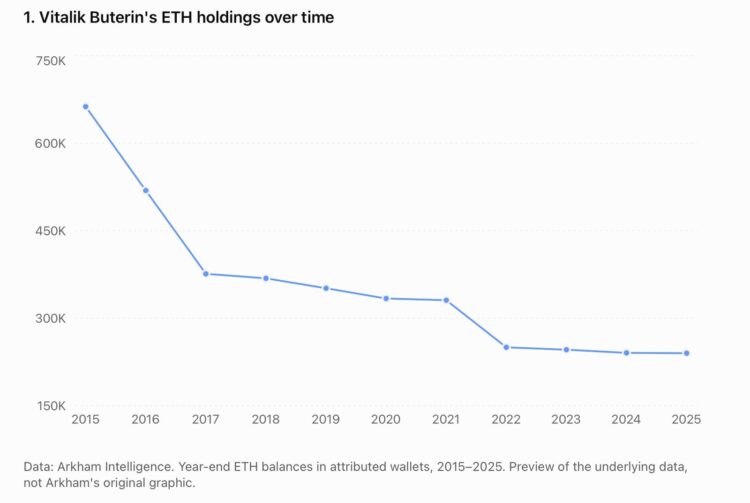
Nevertheless, his actual internet price shouldn’t be publicly established.
Blockchain analytics can estimate the worth of belongings held in wallets attributed to him, however these figures don’t essentially account for all his investments, liabilities, non-public belongings or holdings at addresses that haven’t been publicly recognized.
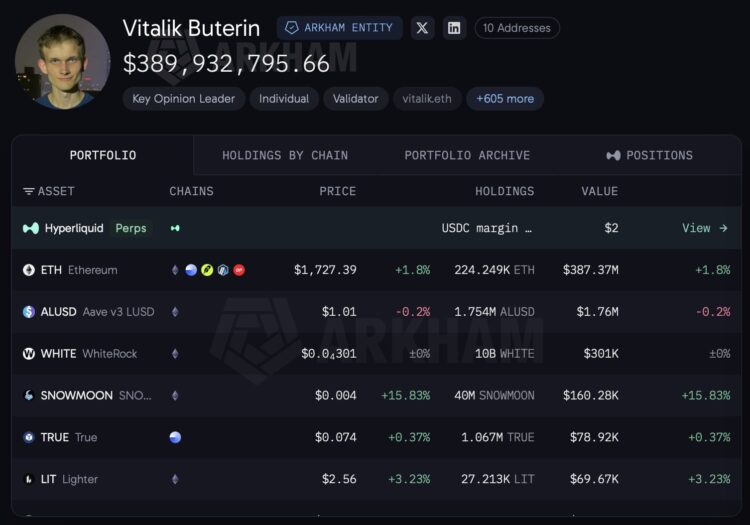
Additionally they fluctuate with cryptocurrency costs. A pockets valuation ought to due to this fact not be confused with an entire evaluation of his private wealth.
What Is Vitalik Buterin’s Imaginative and prescient for the Way forward for Crypto?
Buterin’s newest essay is a part of a longer-running curiosity in making digital infrastructure independently verifiable.
In September 2025, he revealed The Importance of Full-Stack Openness and Verifiability, exploring how transparency may lengthen throughout the {hardware} and software program underpinning more and more necessary components of individuals’s lives.
His broader analysis contains cryptography, privateness, blockchain scalability and Ethereum’s transition towards larger quantum resistance. Buterin has beforehand known as for larger experimentation throughout Ethereum’s utility layer with out compromising its core ideas of censorship resistance, open-source growth, privateness and safety.
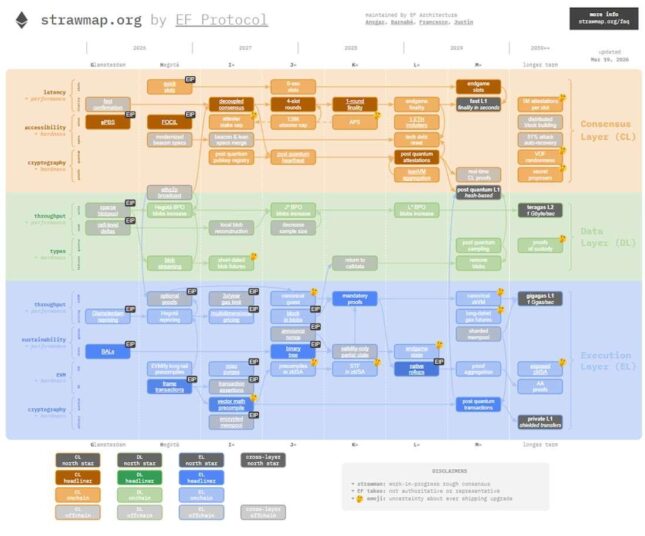
These pursuits share a sensible concern: whether or not customers can independently set up that the techniques they depend on behave as meant.
There’s a business impediment, although. Semiconductor producers make investments closely in proprietary processes, and designing chips particularly for inspectability can contain efficiency compromises.
However a tool signing a cryptocurrency transaction doesn’t essentially want the computing energy of a contemporary AI processor. That makes security-focused {hardware} a probably helpful start line.
Greater than a decade in the past, Buterin challenged the concept blockchains ought to primarily be used to switch cash. His newest work challenges one other assumption the trade has grown comfy with: that trusting the code is sufficient.
For crypto traders, the following significant growth might come from {hardware} producers prepared to make their merchandise independently inspectable, fairly than one other software program replace promising larger safety.