
Why Binance’s ‘kill switch’ couldn’t stop hackers from draining $6.3B — Explained!

There’s a sure irony in pulling the emergency brake, solely to find that the equipment you’re attempting to cease is working past your attain.
Binance encountered a somewhat costly model of that downside on twenty ninth October. Attackers compromised its pockets signing infrastructure and obtained authority to maneuver cryptocurrency via mechanisms that didn’t depend upon the alternate’s unusual withdrawal course of. Suspending withdrawals may interrupt that course of. It may do significantly much less about permissions already established on Ethereum.
By the point the assault was contained, roughly $6.3 billion had been stolen and Binance’s engineers had developed a specialised process to revoke malicious on-chain authority. The alternate may shut down affected companies, however Ethereum would proceed recognising the delegation till it was explicitly cleared.
Brian Cubellis, Chief Technique Officer at Bitcoin custody platform Onramp, supplied his two cents to AMBCrypto,
Pausing withdrawals turns off the alternate’s personal software program, however it does nothing about permissions the attacker has already written to the blockchain
The excellence is an uncomfortable one for an establishment entrusted with billions in buyer belongings.
Binance subsequently coordinated freezes of stolen funds and commenced replenishing the affected holdings, reporting roughly 98% replenishment by 4th November. Its monetary response was substantial.
Nonetheless, it nonetheless is price questioning what remained potential whereas its emergency controls had been taking impact.
The permission that wouldn’t disappear
By the way in which, for these unaware, the assault started effectively earlier than twenty ninth October and nowhere close to a blockchain.
In line with Binance’s third November incident report, an engineer downloaded a tampered set up package deal for an AI coding instrument in June. The alternate detected the anomaly and changed the system, however the attackers had already gathered intelligence about its workers and infrastructure. Nicely into September, one other engineer was approached via a fictitious recruitment course of involving interviews and a malicious coding task.
By twentieth October, the attackers had used compromised worker programs and inner AI tooling to entry further machines. In doing so, they in the end obtained credentials that opened the way in which to Binance’s pockets signing infrastructure.
All of it paid off on the twenty ninth. Between 20:05 and 20:09 UTC, sizzling wallets transferred roughly 223.46 million XRP, 970,500 SOL and 44.2 million OP to attacker managed addresses. Bitcoin and different belongings adopted. Chainalysis subsequently estimated the general theft at roughly $6.4 billion.
What was probably the most consequential a part of this intrusion although? The attackers gained entry to Binance’s signing infrastructure, the very equipment liable for authorizing transactions.
And, they used that belief towards it.
On Ethereum, the attackers exploited EIP-7702, a mechanism that permits an externally owned account to delegate execution to smart-contract code.
Ordinarily, that flexibility expands what a pockets can do. Right here, in line with Binance, the compromised signing infrastructure was used to grant malicious code execution rights over an Ethereum sizzling pockets. The alternate described 50 signed transactions concerned in manipulating the account’s nonce and establishing the delegation.
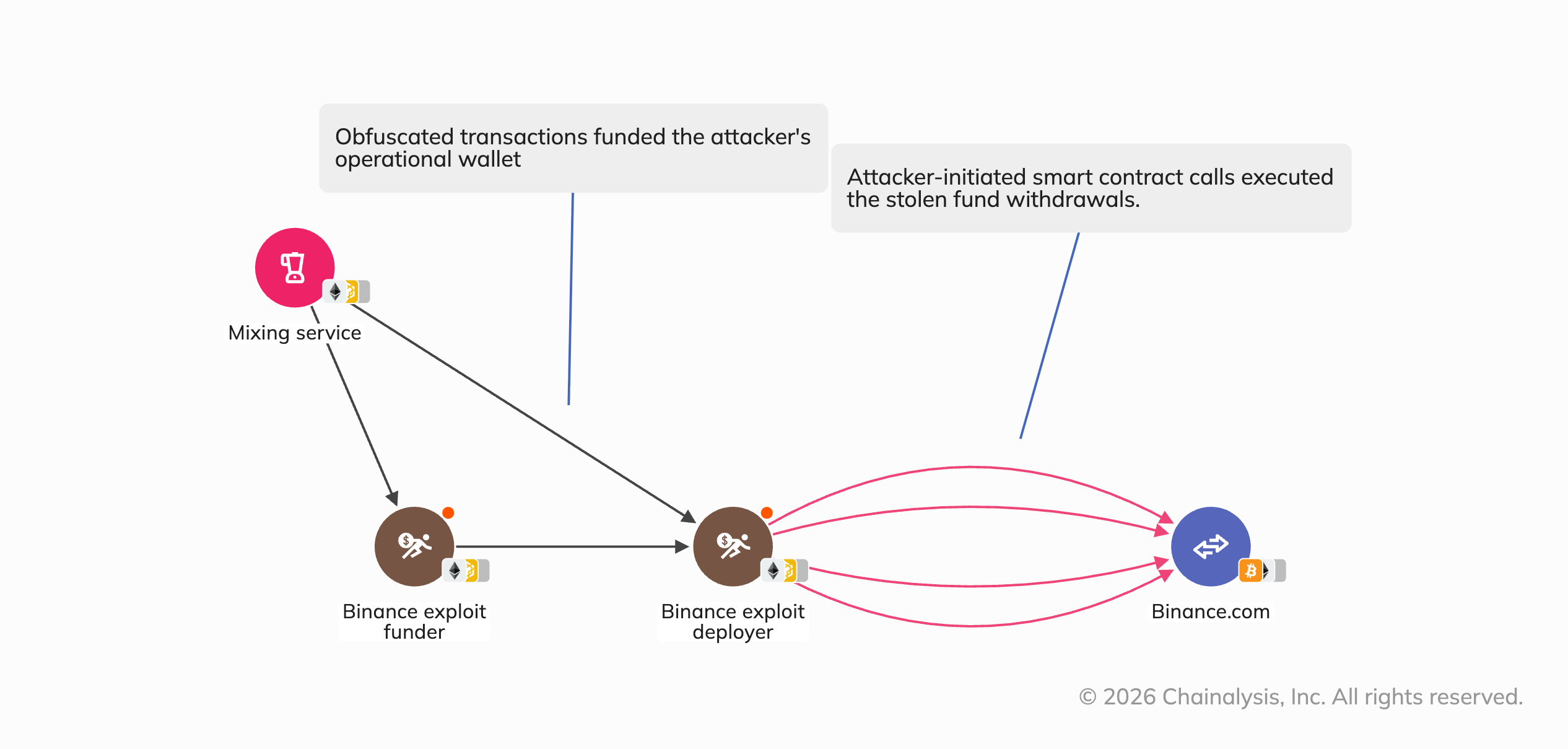
The unsettling half comes subsequent although. These permissions remained legitimate on-chain even after Binance suspended withdrawals and shut down its hot-wallet companies. The alternate may cease its personal programs from processing transactions, however it couldn’t merely change off the authority the attackers had already established on Ethereum.
Then got here one other complication. Binance’s sizzling pockets used multi-party computation (MPC), which distributes the manufacturing of cryptographic signatures throughout a number of members or parts somewhat than counting on a single typical personal key. That structure can scale back sure dangers, however it additionally meant there was no single personal key obtainable to revoke the malicious delegation instantly.
Binance’s engineers needed to DEVELOP a specialised revocation process whereas the incident was UNFOLDING. In fact, this took further time, prolonging the trouble to comprise unauthorized asset actions.
At 23:56 UTC, the ultimate reported unauthorized Ethereum switch, involving 2,961.9 ETH, was confirmed on-chain. Binance mentioned it had been broadcast earlier and remained pending earlier than affirmation. At 00:10 UTC on thirtieth October, the alternate cleared the malicious EIP-7702 delegation with a brand new authorization to the zero tackle.
The excellence between broadcast and affirmation issues. So does the absence of a longtime whole for funds transferred after withdrawals had been suspended.
Binance acknowledged that suspension alone couldn’t cease each unauthorized motion, however its disclosures don’t set up a reconciled post-suspension loss determine.
A kill change… with circumstances hooked up
There’s a comforting simplicity to the thought of a kill change. One thing goes unsuitable, somebody pulls the plug and the injury stops. Sadly, the blockchain has no explicit obligation to respect an alternate’s inner emergency procedures.
Contemplate a lodge discovering that somebody has obtained an unauthorized key card. Closing reception prevents new playing cards from being issued. The present card nonetheless opens the door. Cancelling it, securing the property, and recovering what has already disappeared are separate jobs.
Now, this comparability has its limits, however it captures the dilemma going through exchanges whose pockets permissions outlive their very own programs.
The issue surfaced in a public exchange between Haseeb Qureshi, Managing Accomplice at Dragonfly, and Tudor Anastasiu. Tudor Anastasiu is a blockchain infrastructure and safety engineer and the founding father of Anastasiu Labs.
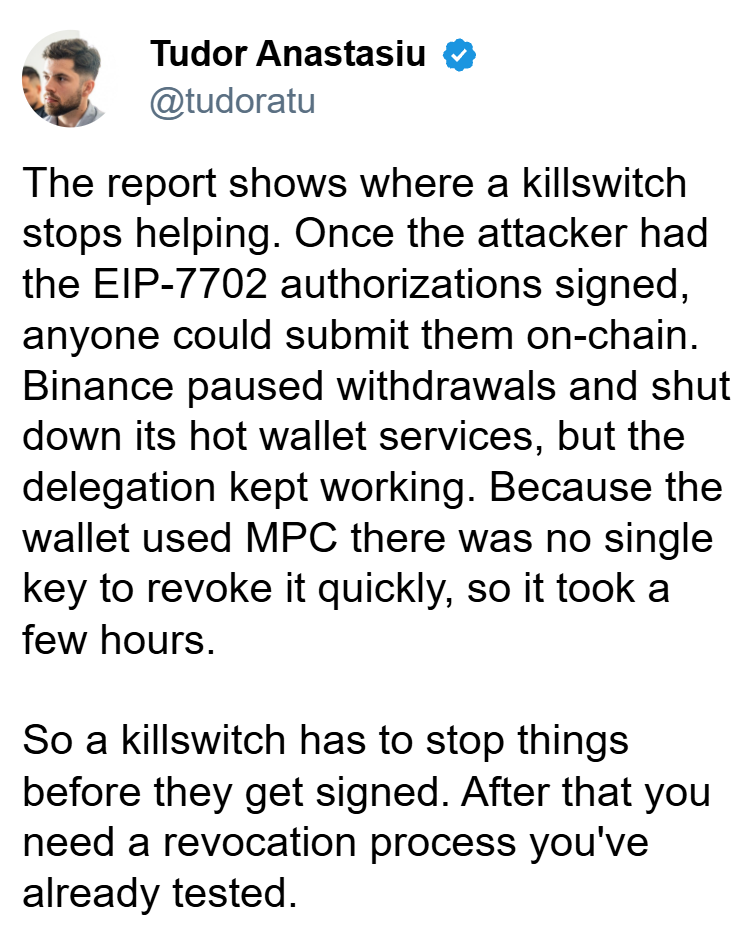
The disagreement exposes a distinction that’s straightforward to miss in the course of a breach.
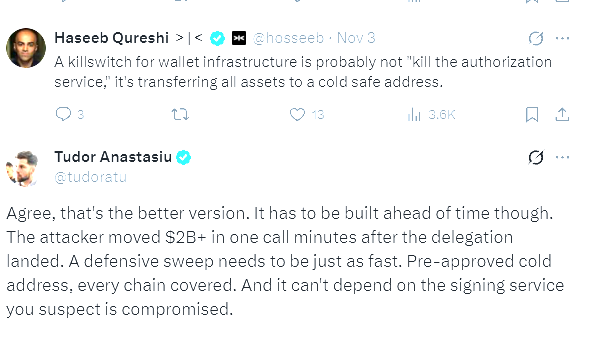
A defensive sweep can transfer belongings to security, offered the alternate can authorize and execute it earlier than the attacker does. Nonetheless, transferring funds doesn’t essentially invalidate permissions already granted on-chain and it actually can not retrieve belongings which have already disappeared.
So, that leaves a somewhat awkward query: If the signing infrastructure itself has been compromised, how does an alternate authorize an emergency transaction with out trusting the very system it suspects?
Carlos Vendrell, Founding father of Zealynx Safety, sees the reply in testing the process below precisely these circumstances.
The drill ought to begin from a listing of each approval and delegation every sizzling pockets has given, then revoke one in all them for actual whereas assuming the traditional signing service is the compromised half, and time it
Binance’s expertise doesn’t set up that MPC inherently prevents fast revocation. Nor does its disclosure show that no emergency process existed earlier than the breach.
Nonetheless, it does set up that engineers developed a specialised process throughout the incident and doing so took further time.
The pockets that saved getting fed
There was one other complication right here, one which made the scenario look virtually absurd. The compromised pockets was reportedly STILL receiving cash.
In an analysis dated 4th November, 4 Pillars reported that Binance’s deposit-consolidation system continued accumulating funds right into a compromised Ethereum pockets recognized as Binance 14. This allowed the attacker to brush newly arriving belongings.
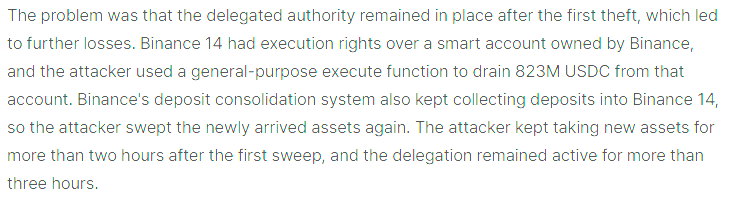
Nexus Mutual’s reconstruction presents a very placing sequence.
At roughly 21:44 UTC, it says the attacker swept 200 million USDT that one other Binance-labelled pockets had deposited roughly 72 seconds earlier. Seventy-two seconds! Barely sufficient time to make a cup of espresso, but apparently enough for a contemporary switch to achieve a compromised tackle and disappear.
The researchers’ findings increase an issue distinct from EIP-7702. An alternate can work to revoke an attacker’s authority whereas different operational programs proceed directing funds in direction of a harmful vacation spot. Interrupting these inner asset flows is one other containment activity and requires its personal controls and affirmation.
In line with Brian Cubellis, emergency preparedness should account for the lack of the standard signing infrastructure.
An alternate ought to show, earlier than it’s attacked, that it may well cancel any permission on its wallets and transfer uncovered funds to security even when its personal signing system has been taken over
That’s simpler prescribed than engineered although.
An unbiased emergency signing path might speed up restoration, however it additionally introduces highly effective authority that have to be secured. Construct an excessive amount of dependence into the unusual system and the emergency route might fail alongside it. Focus an excessive amount of authority within the different and the supposed safeguard turns into one other enticing goal.
Cash strikes quicker than the paperwork
As soon as stolen belongings go away the alternate’s rapid management, containment turns into a race involving investigators, stablecoin issuers, blockchain networks and the attacker.
Chainalysis’s investigation additionally described an try to maneuver roughly $500 million in stablecoins via a swapping tackle. Inside roughly 20 minutes, the attackers reportedly transformed round $325 million into belongings much less inclined to issuer freezes, together with Ether. The remaining $175 million was frozen.
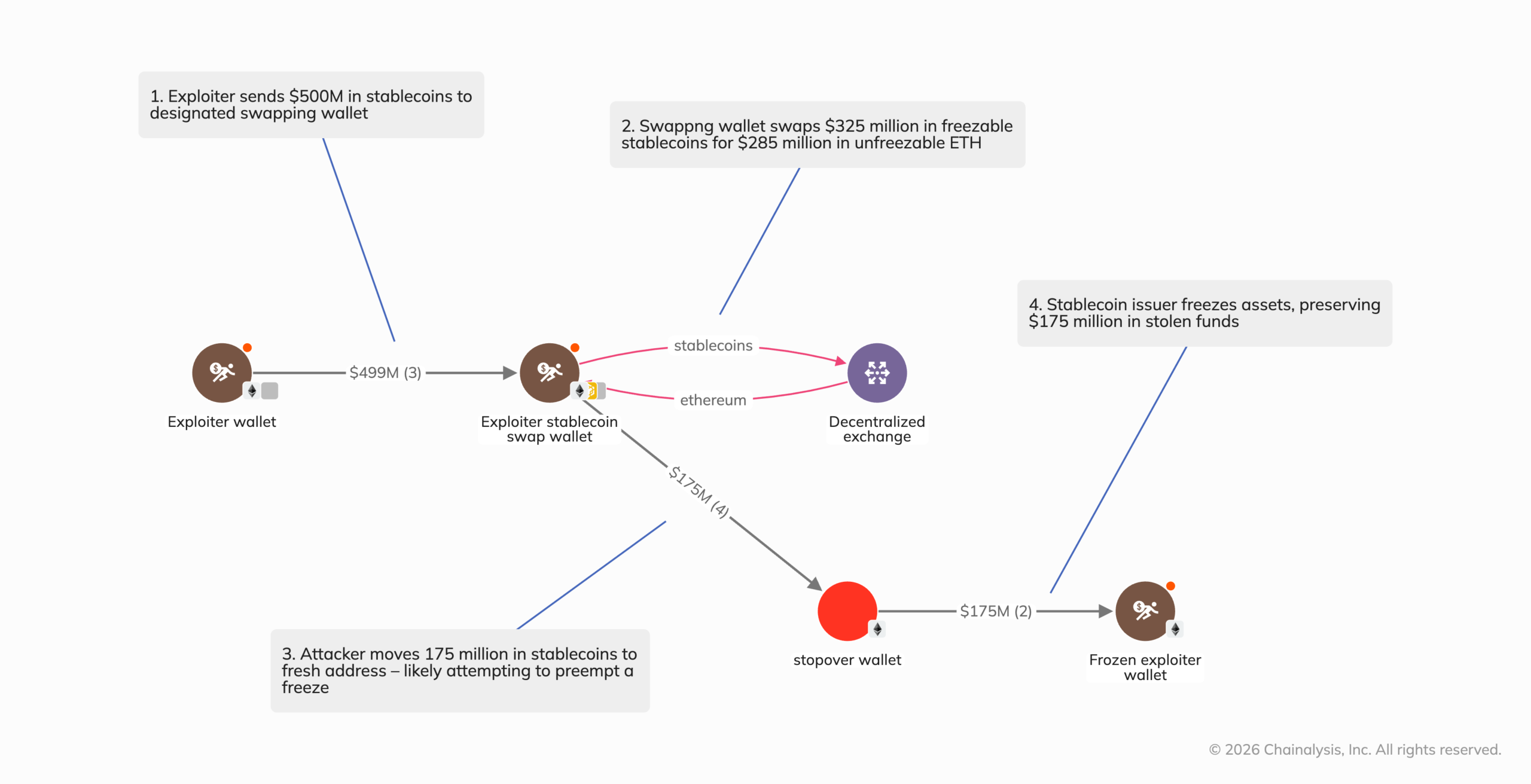
There was a cause for the frenzy. Stablecoin issuers reminiscent of Tether and Circle can freeze sure tokens at designated addresses. Bitcoin and Ether, against this, don’t have any equal central issuer with that energy. Changing the stolen stablecoins into different belongings may due to this fact put them past the attain of an issuer-imposed freeze.
This entire episode illustrates the boundaries of intervention as soon as funds have escaped. Investigators might be able to comply with the cash on-chain, however understanding the place it has gone doesn’t essentially give them the facility to retrieve it.
Binance nonetheless managed to safe a considerable portion of the stolen belongings. In its third November report, the alternate mentioned that roughly $2.85 billion had been frozen or intercepted via cooperation with issuers, regulation enforcement, and blockchain intelligence corporations. By 4th November, it reported replenishing roughly 98% of the affected holdings via substitute purchases.
In fact, Binance had demonstrated appreciable capability to soak up the losses somewhat than go them on to customers. Nonetheless, it tells us how a lot the alternate managed to safe or exchange, not how successfully it prevented the attacker from persevering with to maneuver belongings throughout the breach.
When legitimate signatures authorize a theft
A yr earlier, Bybit had encountered a special model of the issue with compromised transaction authority. In February 2025, attackers stole roughly $1.5 billion after compromising the setting related to its Protected{Pockets} approval course of.
In line with Bybit’s forensic disclosure, malicious modifications deceived signers into approving an unauthorized transaction. It additionally mentioned that investigators discovered no indication that its personal infrastructure had been compromised.
Each incidents uncovered how a lot will depend on the integrity of the authority behind a transaction. A number of signatures provide restricted safety when signers are misled about what they’re approving. And as Binance found, shutting down a signing service doesn’t essentially invalidate authority already established on-chain.
What does the “kill change” really kill?
An emergency kill change sounds reassuring. Relatively much less reassuring is discovering, midway via a breach, that the attacker has permissions your change can not revoke.
Binance’s expertise raises an uncomfortable query for exchanges entrusted with billions in buyer belongings — Have they really examined what occurs when the programs liable for defending these belongings grow to be a part of the assault?
An alternate ought to be capable of reveal that it may well revoke compromised permissions, transfer uncovered belongings to security, and interrupt inner transfers with out relying completely on infrastructure it may well not belief.
However what ought to clients make of an alternate’s public assurances when a breach is underway? AMBCrypto put that query to Vik Sharma, Founder and CEO of Cake Pockets,
A helpful replace names which approvals had been revoked, which belongings moved, and the place, so clients can examine it themselves
There are professional causes to withhold delicate operational particulars whereas an intrusion is underway. As soon as the rapid hazard has handed, nonetheless, an alternate ought to be capable of clarify what its emergency controls really stopped, when compromised authority was extinguished, and whether or not any belongings remained uncovered.
Binance deserves credit score for publishing particulars of its response, coordinating substantial asset freezes, and committing its personal assets to replenish affected holdings. These measures helped take up the monetary injury. Nonetheless, additionally they revealed why reimbursement and containment ought to by no means be confused.
A kill change can purchase defenders management, not merely time to determine the place management has gone.
Last Abstract
- Binance’s signing infrastructure, unbeknownst to them, was compromised effectively earlier than the hack.
- This episode and the one involving Bybit reveal that a lot will depend on the integrity of the authority behind a transaction.